Experience the legendary inca trail to machu picchu hike and discover why this four day premium expedition is the most sought after adventure in South America. Guided by our elite local experts you will conquer ancient stone steps, ascend the towering heights of Dead Woman’s Pass, and traverse lush cloud forests filled with hidden ruins. Your physical effort is instantly rewarded the moment you arrive at the iconic Sun Gate to witness a spectacular sunrise over the citadel. Because the Peruvian government strictly limits daily access official permits sell out months in advance so secure your spot today for a once in a lifetime journey where personal triumph and centuries of history collide.
- Overview
- Itinerary
- Prices
- Packing List
- Travel Info
- Faqs
Inca Trail Hike to Machu Picchu
The inca trail to machu picchu is widely considered the most important trekking route in the Western Hemisphere because it combines diverse ecological zones with the majestic stonework of the Inca Empire. This historic path was a sacred branch of the ancient Qhapaq Ñan which stretched over thirty thousand kilometers to unite the corners of the Tahuantinsuyo.
Unlike other routes an inca trail cusco to machu picchu expedition is the only way to experience the original ritual entrance to the 15th century citadel through the legendary Sun Gate or Intipunku. Choosing trips to machu picchu inca trail with Uros Expeditions ensures a boutique experience where high end comfort meets deep historical education.
While the route is known for its physical demands our structured service includes an elite team of university trained guides and personal porters who transform the classic inca trail to machu picchu into a manageable personal triumph. We focus on providing a secure and spiritually enriching environment so you can witness the first light of day hitting the sanctuary after four days of challenging yet rewarding exploration of the Andes.
The Spirit of the Andes and the Qhapaq Ñan Legacy
The inca trail to machu picchu is widely recognized as the most significant trekking experience in South America because it is the only route that allows travelers to enter the 15th century citadel through the legendary Sun Gate.
This historic path was a vital branch of the Qhapaq Ñan, a massive road system built by the Inca Empire that once stretched over thirty thousand kilometers across the continent.
Today, an inca trail cusco to machu picchu expedition offers a profound connection to ancient history, taking you through diverse mountain ecosystems that range from high Andean tundra to the lush tropical cloud forests.
DAY 1 STARTING THE ANCIENT FOOTPATH FROM KM 82 TO WAYLLABAMBA
Your inca trail hike to machu picchu begins with an exclusive private pick up from your hotel in Cusco, Urubamba, or Ollantaytambo between four and five in the morning. After a scenic drive through the heart of the Sacred Valley you will arrive at Kilometer 82 which is the official starting point of the inca trek peru. Here you will meet your elite support team of professional porters and chefs before crossing the bridge over the Urubamba River to begin the expedition.
The first day is designed with a moderate pace to help your body adjust to the thin Andean air and the unique geography of the trail. You will visit the sprawling complex of Patallacta which functioned as a major administrative and religious center for the Incas in the fifteenth century.
Your expert guide will lead you to Willkarakay which is a military post situated on a high ridge that once guarded the route and provided a strategic view of the Cusichaca Valley. The trek continues through native forests and Andean fields for several hours. In the late afternoon you will reach the Wayllabamba campsite where your team will have everything prepared for a gourmet sunset dinner at 3,000 meters above sea level.
- Total walking distance covers 12 kilometers or 7.45 miles
- Starting elevation begins at 2,720 meters above sea level
- Highest elevation of the first day is 3,000 meters
- Trail difficulty is moderate and ideal for acclimatization
DAY 2 CONQUERING THE SUMMIT OF DEAD WOMANS PASS AT HIGH ALTITUDE
Reaching the summit of Warmiwañusca or Dead Woman’s Pass is the primary challenge of the second day of the trek to machu picchu. This 11 kilometer segment is the most physically demanding part of the expedition because you will reach an elevation of four thousand two hundred fifteen meters (13,828 feet).
As you ascend the tropical vegetation gives way to high altitude grasslands where the air is thin and the scenery is vast. After a brief celebration at the top you will begin a steep descent into the Pacaymayu Valley where your camp is nestled at 3,580 meters for an evening of professional recovery.
- Walking distance covers 11 kilometers or 6.83 miles
- Highest point reaches the dead woman’s pass height of 4,215 meters
- Difficulty level is high due to elevation and steep stone steps
GROUP SERVICE
$ 790 USD includes personal porter who will carry your personal items up to 5 kilos
PRIVATE SERVICE
- 01 people 2850 USD
- 02 people 1600 USD
- 03 people 1400 USD
- 04 people 1260 USD
- 05 people 1100 USD
- 06 people 980 USD
- 07 people 900 USD
- 08 or more peoples 850 USD
EXTRA SERVICE
- Hire of sleeping bag 5 season 20 USD
- Walking stick highly recommended! 15 USD
- Single Tent supplement 30 USD
- Additional porter for 5 kg. 80 USD
- Additional night at 3 star hotel 85 USD
University Student Rate
$760 USD for travelers with a valid international student ID.
Child Rate (8 to 17 years)
$740 USD for younger explorers.
HOW TO ACCESS THE INCA TRAIL
If you plan your Inca Trail Hike, you will have to reserve your permit to enter about five months in advance.
“Anyone who hikes along any of the four routes of the Inca trail network to Machu Picchu must have a Inca Trail permit. This includes tourists, tour guides, porters and cooks.”
According to the ‘Master Plan’ of Machu Picchu, prepared by the Ministry of Culture of Peru and Sernanp (National Service of Protected Natural Areas) in 2003, only 500 people a day can access this place, approximately 300 of them are porters and 200 are tourists. Additionally, 300 people per day can enter the Short Inca Trail to Machu Picchu.
Trekking groups are limited to 10 people plus two tour guides or approximately eight people plus one guide. Only licensed and authorized tour operators can book a travel permit. Each year on October 1, permits go on sale for all tour providers who must compete for these permits on a first-come, first-served basis. To obtain a permit, they must present the necessary personal information of their clients, along with partial payment and those of the porters and cooks who will assist them along the way.
Secure Your Inca Trail Tour Permits
The Peruvian government limits access to the inca trail to machu picchu permits to 500 people per day including all staff. This means only about two hundred spots are available for travelers which causes the peak season to sell out six months in advance. We recommend booking your spot for 2026 starting in October of the previous year. Please note that permits are non-refundable and non-transferable once they are issued under your passport number.
Acclimatization Protocol and Fitness
Spending at least two days in Cusco before your inca trail to machu picchu hike is the most effective way to prepare for the altitude. We suggest a training routine that focuses on cardio and leg strength including stair climbing sessions three months before arrival. Proper hydration and sipping traditional coca tea will also help you manage the high altitudes of Dead Woman’s Pass.
Archaeological Sites Visited on the Inca Trail
Llactapata
- An important Inca ruin that was used for multiple purposes, with a ceremonial center, an urban center and a cemetery, among other things. These ruins were discovered by Hiram Bingham, as was Machu Picchu, but it took him much longer to properly excavate them.
Dead woman step
- This is not a ruin, just the highest point on the trail, and a truly incredible sight to behold. This is an authentic and ethical way to interact with the real people of Peru.
Sayacmarca
- Believed to be both a town and a sacred area, the direct translation of Sayacmarca is ‘inaccessible’ (or a place that cannot be entered). Despite the name, visitors can explore the ruins accompanied by a guide.
Phuyupatamarka
- Also known as the city in the clouds, Phuyupatamarka sits, unsurprisingly, above where the clouds gather. It’s a magical place to spend the night, as the morning will greet you with an incredible view, whether of the surrounding valley and ruins you have yet to visit, or a blanket of clouds covering the landscape.
Intipata
- Previously covered in vegetation, Intipata is the place where the sun hits right (which the name implies, which directly translates as ‘Place of the Sun’) and is located at the top of the descent to Wiñaywayna.
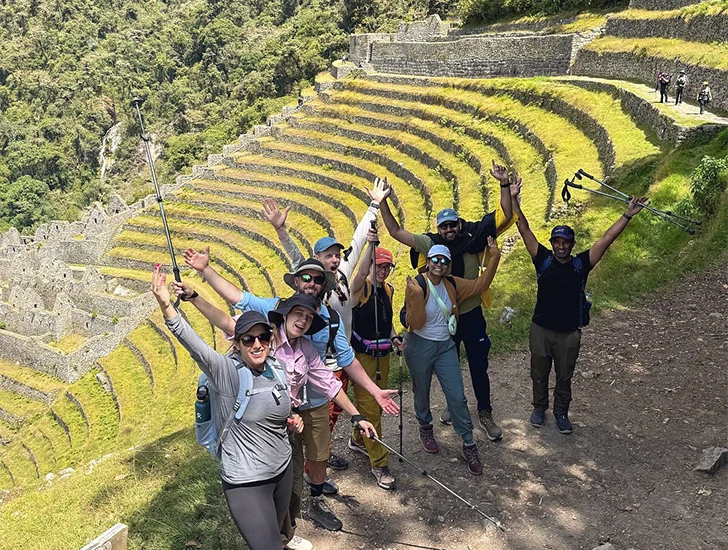
Wiñaywayna
- The purpose of Wiñaywayna is often debated. Regardless of whether it was used as a resting point for visitors to Machu Picchu, or as a religious ceremonial center, these ruins are spectacular, and even more so up close. Just over 3 km from Machu Picchu, they are also the welcome sign of an almost finished hike.
-
t is a long established fact that a reader will be distracted by the readable content of a page when looking at its layout. The point of using Lorem Ipsum is that it has a more-or-less normal distribution of letters, as opposed to using ‘Content here, content here’, making it look like readable English. Many desktop publishing packages and web page editors now use Lorem Ipsum as their default model text, and a search for ‘lorem ipsum’ will uncover many web sites still in their infancy. Various versions have evolved over the years, sometimes by accident, sometimes on purpose (injected humour and the like).
-
t is a long established fact that a reader will be distracted by the readable content of a page when looking at its layout. The point of using Lorem Ipsum is that it has a more-or-less normal distribution of letters, as opposed to using ‘Content here, content here’, making it look like readable English. Many desktop publishing packages and web page editors now use Lorem Ipsum as their default model text, and a search for ‘lorem ipsum’ will uncover many web sites still in their infancy. Various versions have evolved over the years, sometimes by accident, sometimes on purpose (injected humour and the like).
Related tour
Machu Picchu Full Day
Choquequirao Trek 4 Days